


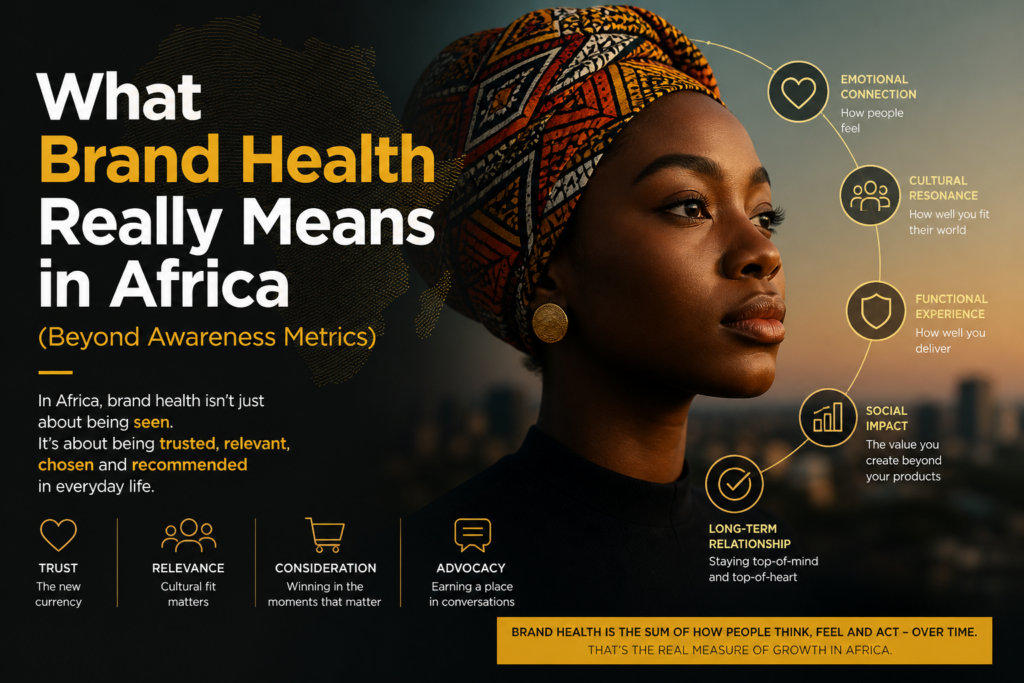
For years, brand health has been measured through a familiar lens: awareness, consideration, and preference. These metrics have long served as the backbone of brand tracking studies. But in African markets—particularly in South Africa—this model is no longer enough.
Because being known is not the same as being chosen.
The Problem with Awareness-Led Thinking
Awareness is easy to build. Media can drive reach, frequency can create familiarity, and over time, brands become recognisable. But recognition doesn’t guarantee relevance. In fact, many brands in Africa enjoy high awareness yet struggle with stagnant growth or declining market share.
Why? Because awareness is a lagging indicator. It tells you where your brand has been—not where it’s going.
In dynamic, economically pressured markets, consumers are constantly reassessing their choices. Loyalty is fluid. Consideration is conditional. And preference can change overnight.
The African Consumer Context
Africa is not a single market. It is a collection of diverse, fast-evolving economies shaped by cultural nuance, income disparity, and rapid digital adoption.
Consumers here are:
- Highly adaptive
- Value-conscious but aspiration-driven
- Deeply influenced by community and culture
- Increasingly exposed to global options
This creates a unique challenge for brands. Traditional frameworks—often built in more stable, developed markets—fail to capture the complexity of decision-making in this environment.
A consumer might be aware of your brand, even like it, but still choose differently based on price sensitivity, social influence, or immediate need.
Moving Beyond Awareness: What Actually Matters
To understand brand health in Africa, we need to shift from visibility metrics to value metrics. The question is no longer:
“Do people know your brand?”
But rather:
“Does your brand matter in their lives right now?”
Three dimensions are becoming far more critical:
1. Relevance
Is your brand aligned with the consumer’s current reality—economically, culturally, and emotionally?
Relevance is fluid. A brand that felt aspirational last year may feel out of touch today. Brands must continuously adapt to shifting consumer priorities.
2. Trust
In markets where consumers are cautious and choices are high-stakes, trust becomes a key driver of conversion.
Trust is built through:
- Consistency
- Transparency
- Delivery on promise
Without trust, awareness is wasted.
3. Momentum
Is your brand gaining or losing energy in the market?
Momentum reflects:
- Word of mouth
- Cultural presence
- Social traction
In Africa’s socially connected environments, brands grow when people talk about them—not just when they see them.
The Gap Between Data and Meaning
One of the biggest challenges in brand tracking today is not the lack of data—it’s the lack of interpretation.
Brands are often sitting on dashboards filled with metrics, yet still unclear on what actions to take. Awareness might be high, but growth is flat. Consideration might be stable, but competitors are gaining ground.
This is where traditional research falls short. It reports what is happening, but not why it matters or what to do next.
Rethinking Brand Health for Africa
Brand health in Africa needs to be understood as a dynamic system, not a static scorecard.
It requires:
- Continuous tracking of consumer sentiment
- Contextual understanding of cultural and economic shifts
- A clear link between insight and strategy
At Trender, this thinking has shaped the development of the Trender Vitality approach—a model designed to measure brand strength through dimensions that actually drive growth: relevance, trust, and momentum, alongside signal and meaning.
Because in today’s environment, brand health is not about how loudly you show up.
It’s about how deeply you connect.
The Strategic Shift
For brands operating in Africa, the implication is clear:
- Stop over-indexing on awareness
- Start measuring what drives decision-making
- Move from data collection to insight application
The brands that will win are not the most visible.
They are the most understood.
Final Thought
In a market as complex and fast-moving as Africa, brand health cannot be reduced to a set of static metrics. It must reflect real human behaviour—messy, contextual, and constantly evolving.
Because ultimately, brand health is not what consumers say about you in a survey.
It’s what they do when it matters most.